Our Relationship With Feelings
By Shanai Cole
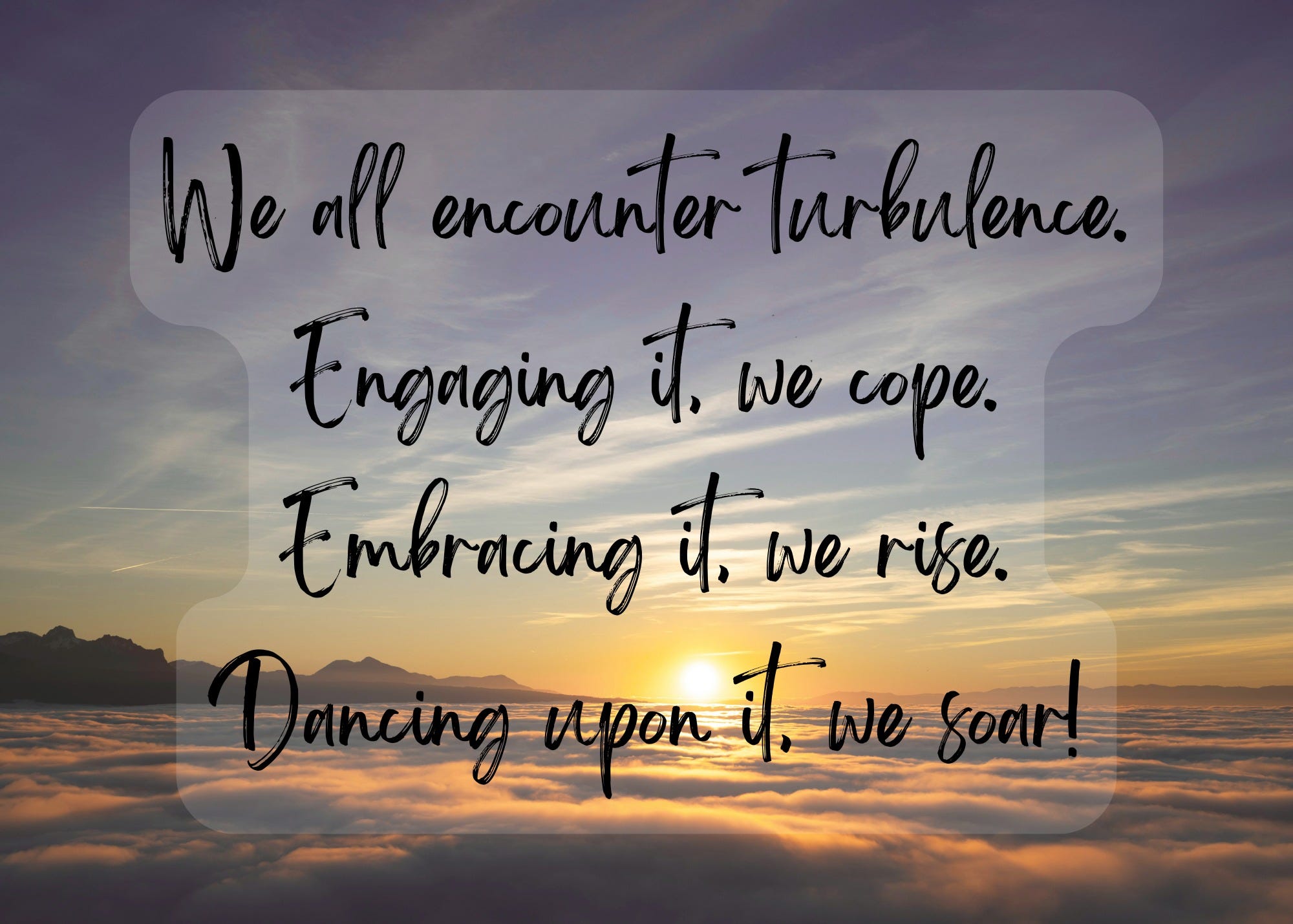
Shanai send me this graphic. I’m sharing it because turbulence comes in many forms. We run into it in many places. It gets our attention. But here is something we need to know: change is supposed to grab our attention. Change grabs our attention for opportunities and for safety.
Two systems navigate us through life. One is conscious. For this system to guide us, we have to be awake and alert. It uses a massive amount of memory.
When something happen to us, this system records what happened. As we go through our day and encounter things, we bring our past encounters back to mind to figure out what to do in the present. The more bad experiences we have had, the more cautious we are. The more cautious we are, the more we process past experiences. The more we process past experiences, the less we stay in the present.
The other system is unconscious. When something negative happens to us, this system codes the cause as negative. When something positive happens, this system codes the cause as positive. This system is very quick. As we go through our day and encounter things, this system reads the previously attached code. A positive reading attracts us. A negative reading repels us. This system doesn’t even require us to be alert. If something important is happening, it alerts us.
Falling is important. Our conscious system is too slow to intervene if we start to fall. The best it can do is to foresee danger. Mainly, we depend on our unconscious system. There, intentional falling is coded positive. For example, fun to jump into a swimming pool. But unintentional falling is dangerous. It is coded, not just negative, but highly negative so that unintentional falling will alarm us.
We can appreciate a system that rightly alarms us when there is danger. But can we appreciate the system that wrongly alarms us of danger when in turbulence?
Let’s try. For safety, this system can’t wait until we are actually falling to alert us. That would be too late. On the ground, we need to be alarmed by the slightest downward motion. In the air, we don’t need to be alarmed at all. But the system does. It alarms us in the air - as it does on the ground - when it senses the slightest downward motion.
There are lots of slight downward motions when flying. But they, all of them, are false alarms. Though nothing bad happens physically, a lot that is bad happens emotionally. Alarm after alarm after alarm wrecks us. If it didn’t leave us so drained, we might be able to appreciate a system that errs on the side of safety for our own good. It’s just that it errs, and it errs, and it errs. It’s hard to appreciate a system that overdoes its warnings using feelings we hate.
If we didn’t hate the feeling, we might learn to ignore it. But, if we learned to ignore it, that would not be good. We could be injured by a avoidable fall.
I have some carpal tunnel syndrome. It has advanced to the point that two fingers on my right hand cannot feel pain. I know the oven and the trays of food are hot. Though I do my best to focus on hot things in the kitchen, I have repeatedly gotten burns on those fingers. The odd thing is, I don’t know I have gotten burned until I happen to see the blisters. Even then, I can’t remember what happened that caused the blisters.
I have a burn on one of my fingers now. I have mixed feelings about that. I am thankful that - because of damage to the nerve - the burn doesn’t hurt at all. But I am not thankful that - because of the nerve damage - I have burned my finger repeatedly and probably will again.
Is there a lesson here about clear air turbulence when flying? Would you like to have nerve damage that would keep you from being disturbed by the movements of the plane? Maybe. But would you like to have that nerve damage if it kept you from being alarmed if you started to fall down the stairs?
I’m asking for some appreciation of the system that warns us wrongly in the air because it warns us rightly on the ground. What more could we expect from a system that was developed thousands of years before the Wright brothers even thought of building a flying machine. Which takes us back to Shanai’s graphis:
If we can engage with our feelings, we cope.
If we embrace our feelings, we rise from anxiety and from depression.
If we dance with our feelings, we celebrate the essence of life, and we soar.