Trust Me On This
Flying a jet fighter in thick fog, there is only one thing you can see outside your plexiglas canopy. Everything else is white. It is a blade of aluminum, the wing tip - and a few feet of the wing - of another jet fighter. The fog is too thick for you to see the pilot in the other plane’s cockpit. You can see only a few feet of the wing before it vanishes into the whiteness.
The whiteness is not always so thick. Most of the time, you can see the full length of the wing, as well as the head - or rather the helmet - of the pilot in the other plane. A dark plexiglas visor and a green oxygen mask are covering his face. But you know that, inside that helmet, is a person you have entrusted your life to.
What you are doing at the moment is illegal. You do it because it is necessary. Your radios - including your navigation radios - went out. If you were flying an airliner, you would have backup radios. You would have backup ways of powering them. In an airliner, you would never be in this position.
But in a jet fighter, you don’t have backups. This means you have to keep that wingtip, as it slices through whiteness, in sight. If you lose sight of it, you will have no way to get your plane back on the ground. That is why you fly illegally close to the other plane. Most of the time, the whiteness lets you see the helmet of the pilot in the cockpit of the other plane. But once in a while - and you never know when - the whiteness gets so thick that you only see the wingtip.
That is why you keep that wingtip, which is moving at several hundred miles per hour, just five feet from you. The rule is you must keep a much greater distance. The rule says you must maintain” wingtip clearance,” at a minimum, twenty feet away. But if you followed the rules, when the whiteness gets thick you would see nothing. You would not know where the other plane - the plane whose every movement you mimic with your plane - is. So you break the rules and retain contact.
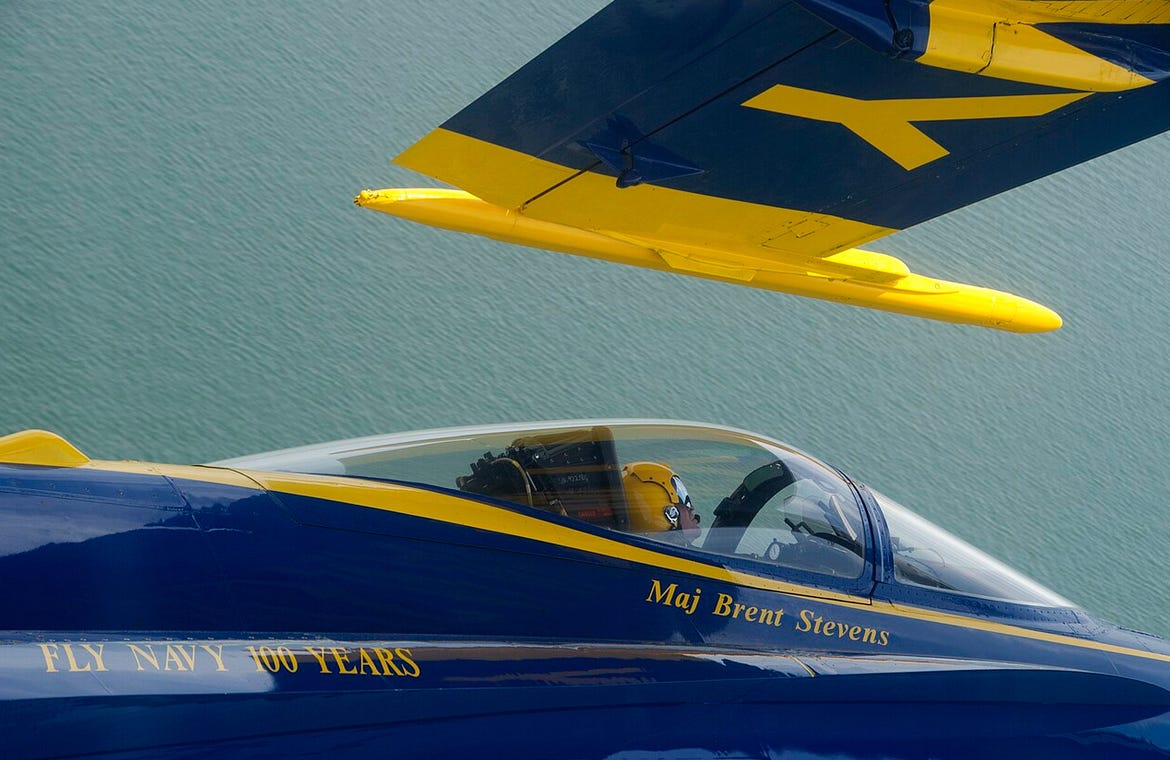
You are flying closer than the Thunderbird or Blue Angel acrobatic teams fly. The skills are the same. The level of talent is the same. Two of the pilots in my squadron later flew with the Thunderbirds.
As you duplicate the movements of the lead aircraft, you notice your throttle is almost back at idle. Almost, because the lead pilot knows you, as the plane flying in reference to his wing tip, must be able to adjust your power to stay in this position.
You see him give a signal with his right hand. He is going to extend the speed brakes. He tilts his head back. When he snaps it forward, at exactly that moment, he extends his speed brakes, and you extend yours.
Now you are going downhill through the whiteness at four thousand feet per minute. You are headed toward a runway thirty miles straight ahead. Neither you nor he can see it up ahead. He, but not you, has navigation radios operating. His radios are guiding his plane, and your plane, as you fly in reference to the wing tip of his plane, down toward that runway.
Minutes pass. He gives that hand signal for the speed brakes. This time, it means retract the speed brakes. He puts his head back. He snaps it forward. In unison, the speed brakes of both planes are retracted. Your descent rate slows. To stay in position, you are moving the throttle a bit forward, and a bit more forward.
There is another hand signal. This one is for the landing gear. He tilts his head back. When he snaps it forward, both you and he move the gear handle down. The landing gear extends in unison.
If someone could see this, it would be like watching two lovers dance. But no one can see everything happening in unison. A beautiful dance is taking place, and no one sees it.
Another signal. This time, the landing flaps are put down in unison. Now, with the landing and the flaps extended, the additional aerodynamic drag is slowing both planes to their landing speed. The landing speed is one hundred eighty knots. That is 207 miles per hour. Unless you have a very high-performance car, you can’t go as fast as that on a highway. But that is the slowest these two planes can be moving when they touch the runway.
It just happened. Your wheels touched the runway without you seeing it. You were focusing on that wing tip.
Now, having been plunked on the runway by the other pilot, you are on your own. You pull the handle that deploys your drag chute. You keep to the right side of the runway. He stays on the left. You apply your wheel brakes. There is a mile and a half of runway ahead of you, enough to slow down to taxi speed.
You exit the runway. You release the drag chute from your plane in the designated area. You taxi to the ramp. The mechanic who saw you off a little over an hour ago gives you hand signals to park. Then, he signals you to cut the engine. You do.
Your flight is over. But one thing is never over. It is unique. It is that you trust any pilot in your squadron to put you back onto the runway if you lose your radios. And they trust you to do that for them. You trust them with your life. They trust you with theirs.
This was a real situation in which the radios of the jet fighter I was flying went out. To be prepared for a real situation like this one, you practice. You take turns putting them on the runway and being put on the runway by them.
There’s no experience I know of that creates such deep trust in another person, and vice versa. It’s unmatched in everyday life. And I miss it.
When you plan to fly, you wonder if you can trust your pilots. The question arises because you have never had the experience I just shared with you. It may arise because you are not sure there is anyone you can truly trust. If there is, your trust in them isn’t put to the test as routinely as it is when flying fighters.
Please understand. I have repeatedly written about trusting male pilots; when I flew fighters, it was before females commonly flew fighters. These days, the trust pilots have in other pilots extends to both males and females.
When you board your airliner, if you meet your pilots, you will get a sense - I don’t know how, but you will - that you can trust your life with them.
If you don’t meet them, you can still trust them. It’s just that you will miss out on that direct, gut-level feeling that in their care, you are safe.